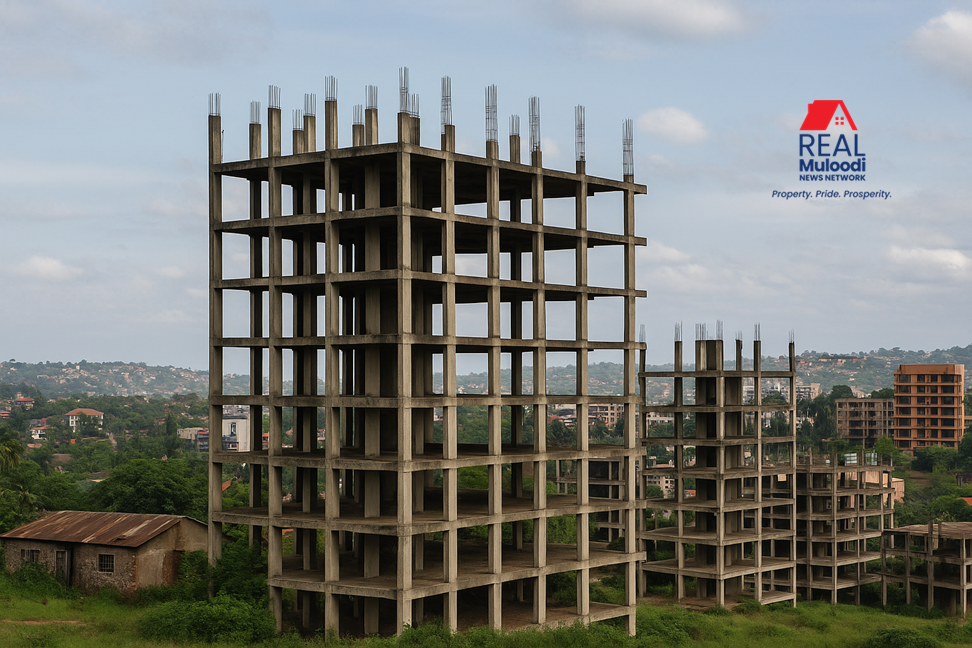
UGANDA, Kampala | Real Muloodi News | Along the rising skyline of Kampala, unfinished concrete skeletons stand frozen in time, casting long shadows over the bustling streets below. These structures—some towering, others modest—tell a silent story of ambition interrupted, dreams abandoned, and a city growing faster than its systems can support. They are the ghost towers of Kampala, reminders of projects that started with confidence but stalled before reaching completion.
Across neighbourhoods like Najjera, Bukoto, Kisaasi and parts of the city centre, these abandoned buildings are impossible to miss. Some have stayed untouched for years, their cement pale from weathering, steel reinforcement rods jutting toward the sky like thin, rusting fingers. Others are partially occupied even before completion, with shopkeepers or tenants improvising life between naked concrete walls. What they all share, however, is a sense of incompletion—a suspended story.
Developers often begin with bold visions, but the reality on the ground quickly complicates those dreams. One property consultant notes that runaway construction costs, land disputes and inconsistent project financing have stalled dozens of buildings across the capital.
“Most people don’t start out planning to abandon a structure,” he says. “But when the money dries up or ownership becomes contested, the building simply stops.”
Economic shocks also play a role. Fluctuating material prices, high interest rates and the unpredictable nature of Uganda’s construction sector often push developers beyond their financial limits. Once a project stalls, restarting it can become even more difficult, especially when lenders tighten access to credit or when accumulating debts make the venture no longer viable.
Yet behind every ghost tower lies a deeply human story. Take the case of a mid-rise building in Kisaasi, whose developer began construction a decade ago with hopes of creating modern apartments for young professionals. The project halted halfway through after his business collapsed. Today, shrubs creep along the ground floor, while the upper levels remain exposed to the wind. Local residents say they have grown accustomed to its presence, though they still wonder when the structure will finally come to life.
“It’s sad,” says a shopkeeper whose kiosk faces the abandoned site. “We watched it come up slowly, and we thought it would change this place. Then one day, the workers stopped coming. Months passed. Years passed. Now we don’t even talk about it anymore.”
Urban planners argue that the issue extends far beyond individual developers. Weak regulatory oversight, poor project assessment and inconsistent urban planning contribute to Kampala’s growing number of incomplete structures. Without stronger systems to evaluate project viability, many buildings break ground without firm financial backing.
Others never had the proper approvals in the first place. A city official familiar with development compliance explains, “We sometimes find that what was approved on paper is not what is happening on the ground. By the time enforcement comes in, the developer has already sunk too much money, and the project stalls.”
Despite the challenges, Kampala continues to grow, and with it the hope that some ghost towers will one day awaken. A few have already resumed construction after ownership changes or fresh financing. Others stand quietly, waiting for new plans or new hands to revive them.
For now, they remain part of the city’s landscape—monuments to ambition, cautionary tales for future developers, and haunting reminders of the delicate balance between vision and capacity. In a city transforming as rapidly as Kampala, the ghost towers serve as silent witnesses to both its promise and its pitfalls.
READ MORE LIKE THIS:
Housing Finance Bank Urges Stronger Systems to Boost Mortgage Uptake