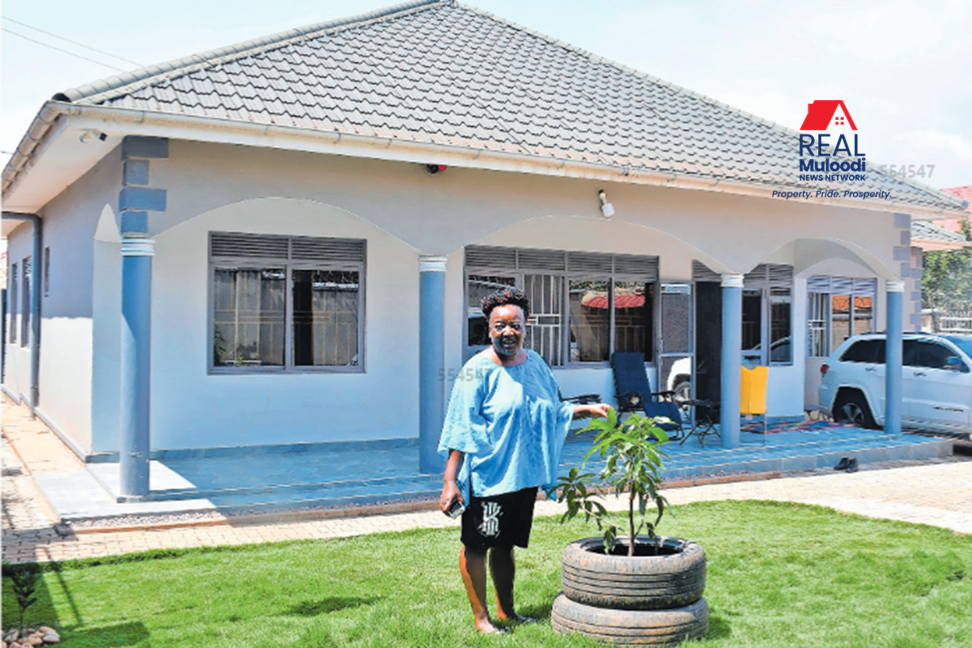
UGANDA, Kungu | Real Muloodi News | For more than two decades, a Ugandan nurse Annet Malokweza has lived and worked in the United Kingdom. Each time she returned to Uganda, she found herself staying either in hotels or at her parents’ house. Comfortable as they were, neither gave her the sense of permanence she longed for. The idea of a home in Uganda grew stronger with every visit, but her journey to ownership took an unexpected turn.
“I had always wanted a place of my own back home,” Malokweza explained. “But after being disappointed with relatives who misused the money I sent, I realised I couldn’t rely on others to build for me.”
From Building Dreams to Buying Reality
Like many Ugandans abroad, Malokweza first considered constructing a house from the ground up. But stories from friends and colleagues discouraged her. Some had sent money for construction only to return years later to find half-finished buildings or structures that did not resemble their plans. Others watched costs spiral out of control.
“I heard so many heartbreaking stories,” she said. “People would send money, and when they came back, they found nothing close to what they expected. I did not want to go through that.”
Her concerns deepened when a relative she entrusted with funds to purchase land betrayed her trust. The land was never bought, and the money disappeared. That experience convinced her that constructing a home remotely carried risks she was unwilling to take.
Finding a Home in Kungu
Determined to take control, Malokweza decided to search for an already-built home that she could modify. In 2023, she found a four-bedroom house in Kungu, Kibwa Zone, sitting on a 50 by 100-foot plot. The house came with a perimeter wall, a guardhouse, a laundry room, and a spacious compound large enough to plant fruit trees—something she had always wanted.
The house was priced at USh400 million, a figure she considered fair compared to bare land in the same area, which often cost around USh150 million. The property had once been mortgaged through Housing Finance Bank, but Malokweza settled the outstanding balance, allowing ownership to be transferred in her name.
Transforming the House
Although the property was livable, Malokweza immediately saw areas that needed improvement.
“The house was beautiful on the outside, but the workmanship inside was not up to standard,” she recalled. “Some tiles were hollow when stepped on, the layout was awkward, and a lot of the fittings were of poor quality.”
She set out to renovate. Inside, ceilings were replaced with gypsum boards and fitted with new lighting. The kitchen was relocated to a more practical area and fitted with a two-seater island. One of the bedrooms and a nearby bathroom were combined to create a spacious master suite with a walk-in closet and ensuite bathroom. Old tiles were removed, walls replastered, and fresh coats of paint applied. Bathrooms were modernised with new fittings, while balconies and walkways were retiled.
One of her most striking upgrades was the use of epoxy flooring, a material she had discovered on social media. Though common in Kenya and Tanzania, epoxy is still new in Uganda.
“It is glossy, easy to clean, and very durable,” she said. “The cost was about Shs 12.5 million, only slightly more than tiles, and the finish completely transformed the look of the rooms.”
Outside, she landscaped the compound, redesigned the paved paths, and added an outdoor sink. By the time she was done, the renovations had already cost around USh100 million, with more upgrades still planned.
Hands-On Management
Managing workers proved to be one of the toughest challenges. Malokweza noticed that progress was slow whenever she was away. Determined to speed things up, she moved into the house during renovations and enforced strict routines.
“I made sure work started at seven in the morning and went on until six in the evening,” she said. “I even had to remove radios from the site because they were distracting the workers. Once I put schedules in place, things moved much faster.”
Her presence and insistence on accountability turned weeks of delayed work into days of progress. She personally checked every step, from mixing materials to finishing details, to ensure quality matched her expectations.
Why Renovation Made Sense
For Malokweza, choosing to renovate an old house rather than build a new one gave her security, speed, and control. Within months, she had a home she could live in and continue to improve, rather than waiting years for a construction project to finish.
“Buying and renovating gave me peace of mind,” she said. “I was able to move in quickly, and I could decide exactly what changes I wanted without worrying about whether the house would ever be completed.”
Her journey reflects a growing trend in Uganda where some homebuyers, wary of the risks of remote construction, are turning to existing houses and tailoring them to their tastes. While renovation comes with its own costs and challenges, Malokweza believes it was the right decision.
“I wanted a home that felt like mine,” she added. “Now I have it.”
READ MORE LIKE THIS:
Ali Kimuli Builds a Four-Bedroom House in Record Four Months
Building a Country House: Grace and John Ekudu’s Journey to Owning a Business