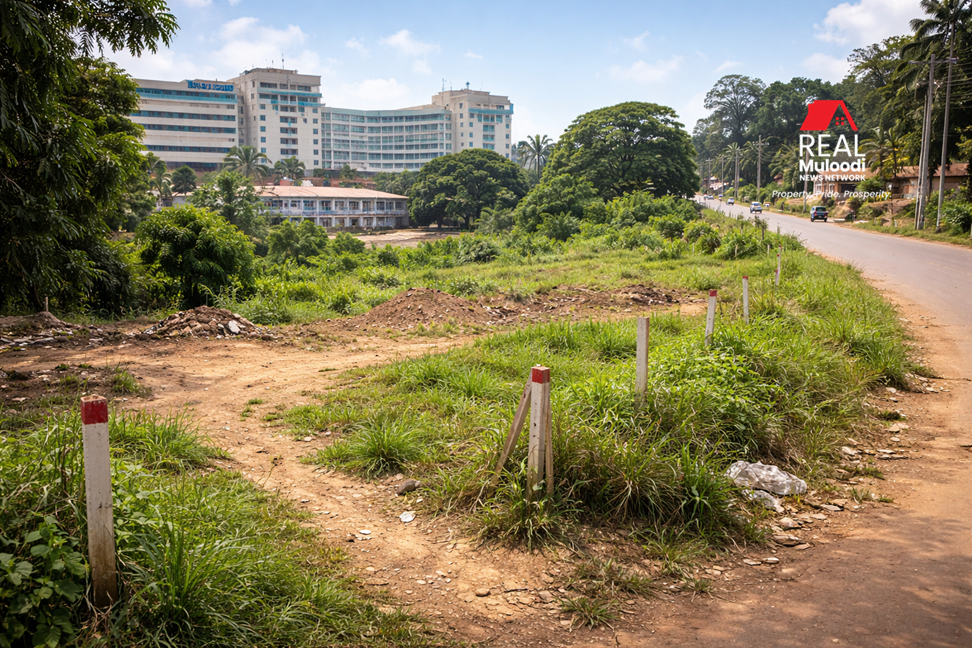
UGANDA, Kampala | Real Muloodi News | Mulago National Referral Hospital has formally petitioned the Kampala Capital City Authority (KCCA) to halt planned development works on a contested parcel of land on Mulago Hill, claiming the property was acquired decades ago and remains part of the public hospital’s estate.
The dispute centres on Plot 790, Block 5, along Dwaliro Road, where KCCA’s physical planning department granted temporary development permission to a private developer to remodel an existing structure. Hospital officials argue that the land belongs to Mulago and that the permit undermines its rights to manage and develop the property.
In a letter dated September 23, 2025, and signed by Dr. John Sekabira on behalf of Mulago’s executive director, the hospital addressed KCCA’s Director of Physical Planning, asserting that the land was acquired under an African Development Bank project between 1996 and 1998.
“There is no Kibanja holder on the land in question since all Bibanja holders at the time of acquisition were compensated and given vacant possession,” Dr. Sekabira wrote, urging KCCA to stop any planned development by third parties on the site.
Mulago’s petition comes after KCCA issued what it described as a temporary development permission to M/s Maldes Advocates to remodel a structure on Plot 790. KCCA’s letter, dated July 4, 2025, granted permission for remodelling of the existing temporary structure, but limited the scope to what was defined in a Ministry of Lands, Housing and Urban Development survey report. The permit also required the developer to obtain a building permit in line with the Building Control Act before commencing works.
Officials from Mulago argue that because the hospital acquired the land decades ago using project funding, it holds superior rights and interests.
The contested parcel forms part of an area that the hospital management says was officially sanctioned as public land, including parts now used to access Dwaliro Road. In his letter to KCCA, Dr. Sekabira requested that the authority halt all development activity and honour the hospital’s ownership rights.
The letter was also copied to multiple government offices, including the Solicitor General, the Ministry of Justice and Constitutional Affairs, the Permanent Secretary of the Ministry of Health, the Secretary of the Uganda Land Commission, the KCCA Executive Director, and the town clerk for Kawempe Division, where the plot is located.
Legal analysts say land disputes involving public institutions and city authorities are common in Kampala, where rapid urbanisation and competing interests often lead to conflicting claims.
A land expert noted that hospital land, particularly plantation estates acquired through public funds, should be protected to ensure that essential services are not undermined by commercial or private interests.
“Public hospital land has to be managed with clear title documentation,” the expert said. “When records are ambiguous or not easily accessible, it increases the risk of encroachment and makes institutions vulnerable to contested claims.”
Mulago’s case highlights broader concerns about how land acquired for public services decades ago is documented and managed in fast-changing urban environments.
The hospital’s legal contention is that its acquisition under the African Development Bank project included full rights to develop and control the land, a position that stands in conflict with KCCA’s temporary permit to a private entrepreneur.
The dispute at Mulago also reflects issues raised in previous government audits about health-care land holdings, where lack of clear title documents and overlapping claims have made some properties susceptible to encroachment.
According to a 2019 report by the Office of the Auditor General, some institutional lands including those in healthcare settings were found to be inadequately documented, exposing them to risk of fraudulent transfer and loss of control.
In its letter, Mulago argues that all earlier Bibanja holders were compensated and that the hospital has maintained vacant possession since the time of acquisition, strengthening its legal claim to the entire parcel.
Sekabira wrote that the intention of the hospital management is to protect the land for institutional use, including possible expansions or access improvements necessary for hospital operations.
KCCA has yet to officially respond to the hospital’s petition. In prior interactions over institutional land disputes, city authorities have maintained that permits are issued in accordance with planning regulations and that development must meet planning, structural, and public health standards.
KCCA’s temporary permission also outlined conditions that the remodelled structure must comply with existing laws, including the Physical Planning Act and Building Control Act.
Residents and health advocates say clarity on the matter is important not only for Mulago but for the integrity of public land management in Kampala.
They argue that institutional land should be clearly demarcated and protected to prevent unnecessary conflicts that could disrupt delivery of public services.
As both sides prepare to elevate their positions, legal observers expect the matter to be taken up at higher administrative or judicial levels if a mutual resolution cannot be reached through correspondence.
READ MORE LIKE THIS:
Museveni Pledges Land Fund to Resolve Absentee Landlord Claims in Mubende